
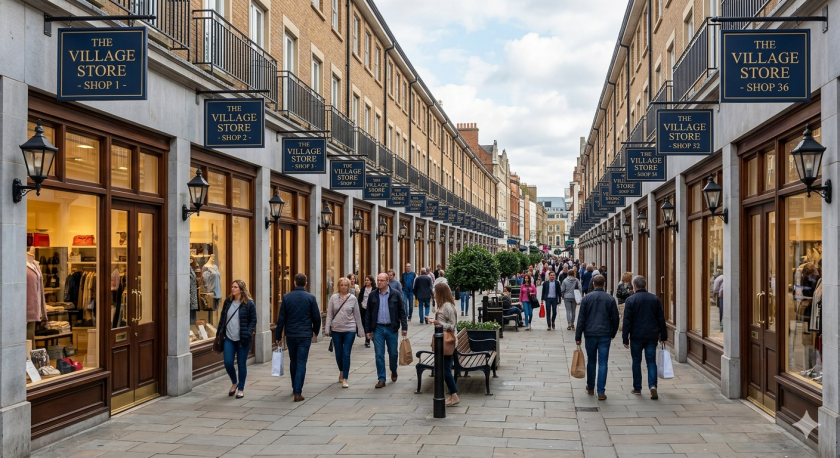
Lost in the Crowd: The Risk for Tourism Spaces
There’s a quiet risk emerging across tourism right now, and it’s not the one most people are talking about. It’s not funding, or demand, or even competition. It’s something more subtle, but ultimately more consequential.
Too many tourism experiences have become easy to say no to.
Not because they’re bad—far from it. Many are beautifully designed, professionally run, and thoughtfully curated. But they are also increasingly interchangeable. And in a world where people are more selective about how they spend both time and money, that interchangeability becomes a liability.
The Sameness Trap
Travel has changed in ways that aren’t always immediately visible. Visitors are no longer simply choosing between comparable offers within a region or category. They are weighing entirely different ways of spending their time: a long lunch against a weekend away, a winery against a wellness retreat, a curated experience against the comfort of staying home.
This shift has raised the bar. Being good is no longer enough. Being attractive is no longer enough. Even being well-designed is no longer enough. When an experience feels replaceable, it becomes optional—and optional experiences are the first to be deferred or dismissed.
Tourism’s Version of the Wine Aisle
In retail, the wine aisle is where even exceptional products struggle to stand out. Rows of bottles present subtle variations in label, story, and promise, but at a glance they blur into a single, indistinct offering.
Tourism is facing a similar condition. Many cellar doors follow a familiar spatial and experiential script. Accommodation is often refined, but generically so—comfortable, well resolved, yet lacking a distinct point of view. Visitor experiences are enjoyable, but predictable in their structure and delivery.
Individually, none of this is problematic. Collectively, however, it creates a landscape where meaningful distinction is difficult to perceive. In that environment, decision-making defaults to convenience, price, and proximity rather than emotional connection.
The Real Challenge Isn’t Differentiation
For years, the industry response has been framed around differentiation—adding more experiences, more layers, more reasons to visit. But more does not necessarily create clarity. In many cases, it introduces noise.
The more pressing issue is that many tourism offers are not clear enough about what makes them worth choosing in the first place. The most successful operators are not those who offer the most, but those who are hardest to substitute. Their value is specific, legible, and difficult to replicate elsewhere.
Design as a Decision Tool
This is where design becomes a strategic tool rather than a visual outcome. The environments people encounter—architecture, interiors, landscape, exhibitions—shape how quickly and intuitively they understand what a place represents.
That understanding happens quickly, often within moments of arrival. The most effective environments communicate a clear identity, guide movement and attention, and create a sense of unfolding rather than static occupation. They prioritise a coherent idea over a collection of features, allowing the experience to feel intentional rather than assembled.
When these elements align, the result is not just a well-designed space, but an experience that is easier to choose and more difficult to replace.
The Overlooked Opportunity
Importantly, this shift does not always require large-scale investment or entirely new infrastructure. In many cases, the opportunity lies within what already exists.
Underperforming rooms, transactional tasting formats, and spaces that no longer reflect the direction of the brand all present opportunities for recalibration. Likewise, moments of arrival, circulation, and transition—often overlooked—can be reworked to build anticipation and strengthen the overall narrative of the place.
This is particularly evident in tasting environments. As we explored in our recent white paper on the realignment of tasting experiences, the spaces that will thrive are not necessarily the newest or the most architecturally ambitious, but the ones that are most attuned to how people actually want to spend time. Comfort, dwell time, and spatial atmosphere are not secondary considerations—they directly influence behaviour, from how long someone stays to how much they engage and spend.
In that sense, performance is no longer just operational or environmental. It is experiential.
These are not necessarily major interventions, but they can have a disproportionate impact. Small, well-considered changes in spatial experience often translate directly into how long people stay, how deeply they engage, and ultimately how much they spend.
Designing for Memory, Not Just Use
Tourism has always been experience-driven, but increasingly it is memory that defines value. What people recall, share, and describe afterwards carries far more weight than the functional aspects of a visit.
Memorable places are rarely the most complex or feature-rich. They are the most resolved. They present a clear idea, executed with consistency and care, allowing visitors to connect with something that feels specific to that place.
It is this specificity that reduces substitutability and builds lasting relevance.
The Places That Will Lead
The next phase of tourism will not be defined solely by new destinations or large-scale developments. It will be shaped by operators who take a more critical view of what they already offer and how it is perceived.
The key question is not simply whether a place is appealing, but whether it is genuinely difficult to replace. In an environment where attention is fragmented and choice is abundant, that distinction becomes critical.
Because the real risk in tourism today isn’t being unknown.
It’s being lost in the crowd.
If you want to explore practical ways to make your tourism spaces stand out, our recent white paper on why some tasting rooms will thrive dives deeper into how spatial design, comfort, and atmosphere influence dwell time, engagement, and visitor experience. Small, considered interventions can create meaningful differentiation—and ensure your spaces aren’t just seen, but remembered.